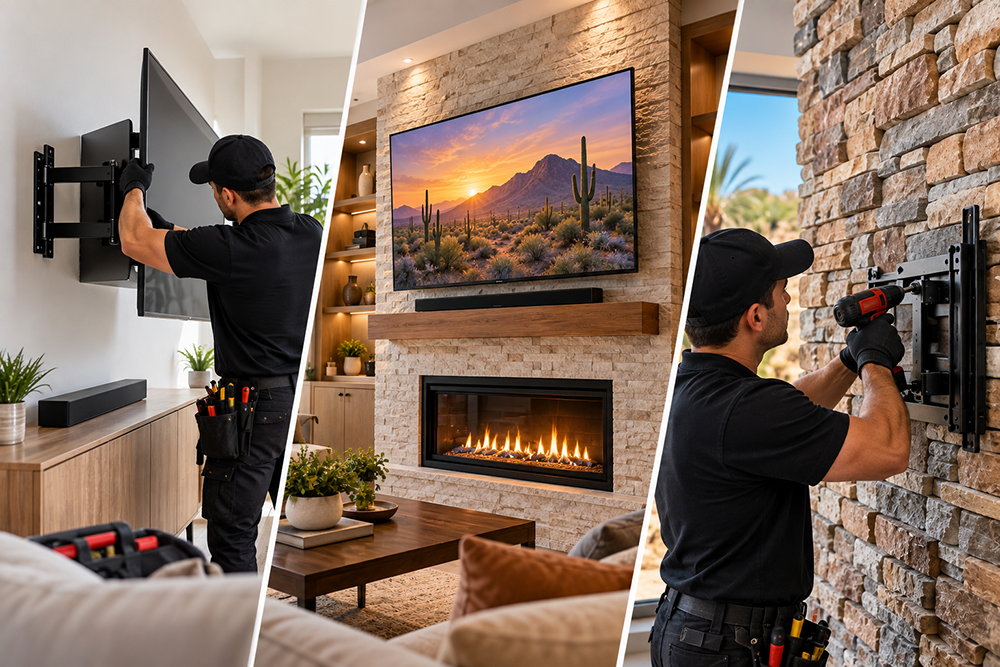
Mounting a TV sounds simple until you look at the wall.
A 75-inch television mounted on standard drywall is one project. The same television above a fireplace is a completely different project. Put that TV on a stacked-stone wall, and almost everything changes again—from the drill bit and anchors to the mounting technique and cable-routing strategy.
This is especially relevant in Phoenix and surrounding Arizona communities, where homes often combine drywall interiors with large fireplaces, decorative stone, tile, masonry, high ceilings, open floor plans, and oversized entertainment walls.
The television may be the same.
The wall is not.
And that’s exactly why professional TV mounting involves much more than drilling four holes and tightening a few bolts.
Let’s look at three of the most common—and very different—TV mounting situations Phoenix homeowners encounter.
Drywall is probably the most familiar surface for residential TV mounting.
It is also one of the most misunderstood.
People often say:
“It’s just drywall. This should be easy.”
The problem is that the drywall itself usually isn’t what should be supporting a large television.
A professional installer isn’t simply looking at the visible wall.
The real question is:
What’s behind it?
Depending on the home, there may be:
The mounting strategy depends on what the installer finds.
For many installations, locating studs provides the strongest mounting points.
This becomes particularly important as televisions get larger.
A modern 55-inch TV may be relatively lightweight, while a 75″, 85″, or 98″ television creates a very different mechanical load—especially when installed on a full-motion articulating mount.
This distinction is important.
With a fixed mount, the television remains close to the wall.
With a full-motion mount, the homeowner may pull the television 15–25 inches away from the wall and rotate it.
That creates leverage.
Think about holding a heavy object against your chest versus holding the same object with your arms extended.
The weight hasn’t changed.
The force on your body has.
A wall mount behaves similarly.
That’s why the attachment method becomes even more important with articulating mounts.
Depending on the wall and mounting system, a professional installer may use:
The goal isn’t simply to make the television stay on the wall.
The goal is to make it secure, level, properly positioned, and visually clean.
Phoenix-area homes vary considerably by age and construction.
A wall that appears completely ordinary can sometimes hide an unexpected configuration.
For example, imagine a homeowner who wants an 85-inch television centered perfectly between two windows.
The problem?
The studs don’t line up with the desired TV position.
A homeowner doing the project themselves might simply move the TV several inches left or right.
A professional installer can evaluate other mounting solutions while maintaining structural safety.
This is one reason professional mounting is partly construction work and partly problem solving.
Imagine a Phoenix homeowner carefully measures the living room wall and marks the exact center.
They buy a large full-motion mount, locate what appears to be a stud, drill the holes, and install the TV.
Everything looks perfect.
Until the television is pulled forward.
One mounting point begins moving slightly.
The problem?
What appeared to be a solid mounting location wasn’t what the installer assumed it was.
With an articulating mount, that small mistake becomes much more important because the extended television places additional leverage on the wall.
The lesson:
Finding the center of the wall is easy. Finding the correct structural mounting points is the real job.
Now things become more complicated.
Fireplace TV mounting is one of the most requested installations because it creates a dramatic focal point.
But fireplaces introduce several questions that don’t exist with ordinary drywall.
Before drilling anything, an installer needs to think about:
Fireplaces naturally push televisions upward.
That’s not always ideal.
If the screen is mounted significantly above seated eye level, viewers may have to look upward for extended periods.
The room layout therefore matters.
A professional installer considers factors such as:
Sometimes a tilting mount is enough.
In other situations, a specialized fireplace mount may provide a better viewing position.
Electronics and excessive heat don’t make good partners.
Before mounting a television above a fireplace, the installer should consider how heat travels around the fireplace and mantel.
The mantel can sometimes help deflect heat away from the television, but every fireplace is different.
Gas fireplaces, electric fireplaces, and traditional wood-burning fireplaces may create very different conditions.
The television manufacturer’s installation requirements should also be considered.
One practical preliminary check homeowners sometimes use is to operate the fireplace normally and evaluate how warm the proposed TV location becomes.
But this isn’t a substitute for understanding the fireplace construction or following manufacturer requirements.
If the wall becomes excessively hot, mounting electronics there may not be appropriate without further evaluation.
This is where fireplace installations can become unpredictable.
Behind the visible surface may be:
Blind drilling is never a good strategy.
The installer needs to understand what the fastener is actually attaching to.
Depending on construction, installers may need:
The exact hardware depends on the actual wall.
There is no universal “fireplace TV screw.”
Picture a remodeled Scottsdale living room.
The homeowner has beautiful floor-to-ceiling stone surrounding the fireplace.
There is already an electrical outlet behind the planned TV location.
Perfect.
Almost.
The homeowner also wants an AV receiver and gaming console inside a cabinet six feet away.
Now the installation isn’t only about mounting the television.
How do the HDMI cables reach the cabinet without crossing the fireplace or destroying the newly installed stone?
This is where installation planning becomes important.
Possible solutions depend on the construction and may include pre-existing conduit, carefully planned cable routes, or alternative equipment placement.
A professional installer thinks about these issues before drilling the first hole.
Stone walls are where TV mounting becomes especially interesting.
Arizona architecture frequently incorporates decorative stone and masonry into fireplaces, accent walls, patios, and entertainment spaces.
They look fantastic.
They’re not always easy to drill.
A wall that looks like solid stone may actually be:
The visible material doesn’t necessarily tell you what’s supporting the TV.
That distinction matters enormously.
Stone presents two competing problems.
You need enough force to create the mounting hole.
But too much force—or the wrong technique—can damage the surface.
Potential problems include:
And unlike drywall, repairing a damaged decorative stone panel isn’t always easy.
You can’t simply patch it, sand it, and repaint it.
Depending on the material, professional installation may involve:
Choosing the correct bit matters.
A tool suitable for ordinary concrete isn’t automatically appropriate for delicate porcelain tile or decorative stone veneer.
Stacked stone creates another challenge.
The surface may not be flat.
A TV mount, however, needs a stable mounting plane.
If the bracket is tightened directly against an uneven surface, several things can happen:
Professional installers may need carefully selected spacers or another appropriate mounting solution to create a stable installation without crushing the decorative surface.
Imagine a homeowner has just completed a luxury living-room renovation in Paradise Valley.
The centerpiece is a floor-to-ceiling natural stone feature wall.
The stonework costs thousands of dollars.
Then someone tries to mount the television using an ordinary drill bit from a basic household kit.
The bit wanders.
The hole chips.
Now the least expensive component of the project—the drill bit—has damaged one of the most expensive surfaces in the room.
This illustrates an important point:
Professional TV mounting isn’t expensive because turning a drill is difficult.
It’s valuable because knowing where, how, and with what to drill can prevent expensive mistakes.
Consider the same 75-inch TV.
The installer may locate structural framing, position the bracket, secure the mount, level the television, and route cables.
Relatively straightforward—assuming the wall construction cooperates.
Now the installer must consider viewing height, heat, fireplace structure, mantel clearance, wall composition, power, cable routing, and possibly masonry.
Now the installer may need specialized drilling equipment, masonry fasteners, careful spacing, and techniques designed to avoid damaging the stone.
Same television.
Three different installations.
Large televisions are increasingly common.
And Phoenix homes often have the wall space for them.
But oversized TVs introduce another consideration:
handling.
A 98-inch television isn’t simply a heavier 65-inch television.
It’s physically enormous.
Moving it through a home, lifting it safely, aligning mounting hooks, connecting cables, and placing it against the wall can require multiple people.
The screen itself can also be surprisingly delicate.
Applying pressure in the wrong place while lifting can damage the panel.
For very large TVs, professional installation is partly mounting and partly logistics.
Here’s another scenario installers encounter.
A homeowner buys a new house.
There’s already an outlet high on the wall.
Naturally, they assume:
“That’s where the previous owner’s TV was.”
Maybe.
But that doesn’t automatically mean the mounting points, outlet position, or cable arrangement work for the new television.
The previous owner may have had a 50-inch TV.
The new homeowner has an 85-inch TV.
The old mount holes may no longer align with the new bracket.
The outlet may even interfere with the mounting plate.
Existing infrastructure can help—but it doesn’t automatically determine the correct new installation.
A professionally mounted television with five cables hanging underneath still looks unfinished.
That’s why the installation plan should consider:
The best time to think about cable management is before the TV goes on the wall.
Not afterward.
In-wall cable concealment may be possible in some installations, while raceways or alternative solutions may be more appropriate in others.
Electrical power wiring must also be handled differently from low-voltage AV cables and should comply with applicable electrical requirements.
You can buy a drill.
You can buy a level.
You can buy a stud finder.
What you’re really paying a professional installer for is knowing what to do when the wall doesn’t behave the way you expected.
That’s where experience matters.
The stud isn’t where it should be.
The fireplace wall isn’t framed as expected.
The stone veneer is thicker than anticipated.
The mounting surface isn’t flat.
The HDMI cable can’t follow the planned path.
The outlet sits directly behind the mounting bracket.
The television needs to be centered somewhere that doesn’t align conveniently with framing.
The soundbar needs to move with a full-motion television.
These aren’t unusual exceptions.
They’re exactly the situations that turn a “simple TV mounting job” into a construction problem.
The wall is only half the equation.
The mount itself needs to match the installation.
Common options include:
Simple, slim, and excellent when the viewing position doesn’t need to change.
Useful when the TV is mounted higher than ideal, including some fireplace installations.
Allows the television to extend, swivel, and tilt.
Excellent for open floor plans and rooms with multiple viewing positions, but the mounting points must handle the additional leverage created when the TV is extended.
Certain installations benefit from mounts designed specifically to improve viewing position above fireplaces.
The right choice depends on the TV, wall, room, and how the homeowner actually watches television.
Phoenix-area TV installation isn’t limited to simple bedroom drywall.
Homes throughout Phoenix, Scottsdale, Glendale, Paradise Valley, and surrounding communities can include everything from basic framed walls to elaborate stone fireplaces and oversized entertainment spaces.
That means an experienced installer may arrive expecting one installation method and discover something completely different once the wall is evaluated.
And that’s normal.
The objective isn’t to force every wall to accept the same mounting technique.
The objective is to choose the technique that fits the wall.
Before drilling anything, determine:
If several of those answers are uncertain, that’s usually a good indication that professional installation is the safer approach.
At TVMountology, TV installation isn’t treated as a one-size-fits-all service.
Drywall requires one strategy.
A fireplace requires another.
Stone and masonry can require specialized equipment and completely different mounting hardware.
The goal is always the same: a television that is secure, properly positioned, level, functional, and cleanly integrated into the room.
Whether you’re installing a 55-inch bedroom TV, an 85-inch display above a fireplace, or a massive screen on a custom stone feature wall, the most important part of the project isn’t the television.
It’s understanding the wall that’s holding it.
TVMountology provides professional TV mounting and installation services throughout the Phoenix area, including installations on drywall, above fireplaces, and on stone or masonry surfaces.
📞 Call us today at (602) 910-8876 and schedule your installation with the Valley’s trusted professionals.
