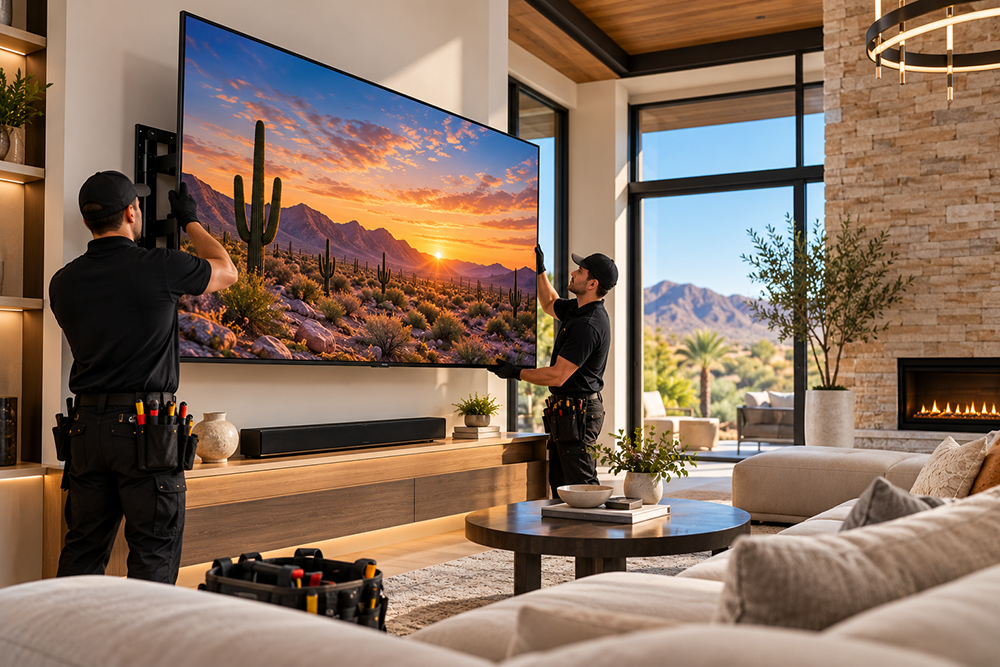
Before you order that giant screen, there’s something important to consider: where—and how—are you going to mount it?
A few years ago, an 85-inch television seemed enormous. Today, 85-inch TVs are a realistic option for many family rooms, and 98-inch screens are bringing an entirely new level of home entertainment to Phoenix-area homes.
But there’s a catch.
Buying a bigger TV doesn’t automatically mean your existing wall, TV mount, entertainment center, or cable setup is ready for it.
In fact, the most challenging part of owning an oversized television often begins after delivery.
At TVMountology, we believe that a successful large-screen installation starts long before the television is lifted onto the wall.
Here’s what Phoenix homeowners should understand before mounting an 85-inch, 98-inch, or similarly oversized television in 2026.
The market for oversized televisions has changed significantly.
Major manufacturers now offer increasingly large 4K displays with Mini-LED, QLED, and other advanced picture technologies.
For example, Samsung’s 2026 U9000H is available in a 98-inch configuration, while TCL’s 2026 television lineup includes several large-screen options.
The result is that homeowners have more opportunities to create a theater-like experience without installing a projector.
But a 98-inch television isn’t just a slightly larger 75-inch TV.
It’s an entirely different installation challenge.
A typical 98-inch 16:9 television has a visible screen approximately:
Those measurements exclude the bezel and any additional space required for installation.
That’s a massive piece of equipment to move through a doorway, lift above furniture, and attach securely to a wall.
And while modern televisions are becoming thinner, their overall dimensions create significant handling challenges.
Installation tip: Before ordering a 98-inch TV, measure the complete delivery path—not just the wall where you want it installed.
Here’s a common scenario.
A Phoenix homeowner already has a 65-inch television mounted on the wall.
They upgrade to an 85-inch TV and assume they can reuse the existing bracket.
Sometimes they can.
Sometimes they absolutely shouldn’t.
The new television may have a different:
Even if the new TV physically fits the bracket, that doesn’t automatically mean the mounting system is suitable.
VESA refers to standardized mounting-hole arrangements used on many televisions.
For example, a television might use a 400 × 400 mm or 600 × 400 mm mounting pattern.
The actual pattern varies by manufacturer and model.
Before installation, the mounting bracket must be checked against the TV’s specifications.
A professional installer also considers the wall structure and the mounting hardware—not just the advertised TV-size compatibility.
A large television mounted close to the wall places one type of load on the mounting system.
Pull that same television 20 inches away from the wall, and the leverage changes dramatically.
That’s why a full-motion mount for an oversized TV needs particularly careful evaluation.
The wall, fasteners, bracket, and manufacturer’s installation instructions must all be compatible.
Many homes throughout Phoenix, Scottsdale, Paradise Valley, Glendale, and surrounding communities feature spacious living areas.
Large walls and open floor plans can make oversized TVs especially appealing.
But those same homes can introduce unexpected installation challenges.
A living room with a 12-foot ceiling may look impressive.
However, placing the television near the top of the wall can make everyday viewing uncomfortable.
The ideal mounting height depends on the seating arrangement, viewing distance, screen size, and room design.
A large TV should be positioned for comfortable viewing—not simply centered within the available wall height.
Phoenix is famous for sunshine.
That’s wonderful for outdoor living, but it can create significant glare on television screens.
Large windows, sliding glass doors, and open-concept floor plans may introduce reflections during daytime viewing.
Before choosing a mounting position, consider how sunlight enters the room throughout the day.
Sometimes moving the TV to a different wall produces a better result than buying a more expensive television.
Many Phoenix-area homes feature decorative fireplaces with stone, tile, or custom surrounds.
A large TV above a fireplace can look dramatic.
But an 85-inch or 98-inch screen may sit too high, extend beyond the desired design area, or require specialized mounting.
Heat exposure, structural support, and cable routing also need to be evaluated.
Yes—but the answer requires an important explanation.
Drywall alone is generally not the structural support intended for mounting an oversized television.
The installation needs an appropriate load-bearing mounting system compatible with the actual wall construction.
Depending on the property, that may involve wood framing, metal framing, or an engineered mounting solution.
A professional installer evaluates the structure before selecting the mounting method.
Suppose a homeowner wants a 98-inch TV perfectly centered on a 10-foot-wide wall.
The desired location may not align conveniently with the available structural framing.
The solution isn’t to ignore the framing and simply install the mount wherever it looks best.
Instead, the mounting arrangement needs to accommodate both the desired position and the structural requirements.
This is one of the biggest differences between professional TV mounting and a rushed DIY project.
Imagine this situation.
A homeowner in Scottsdale orders a beautiful 98-inch television.
The delivery arrives.
The television fits through the front door.
Everything seems perfect.
Then the delivery team reaches the hallway leading to the entertainment room.
The box won’t turn the corner.
Now what?
This is a surprisingly realistic problem with oversized electronics.
Before delivery, measure:
The TV’s shipping carton may be considerably larger than the television itself.
Important: Never assume that a television can be safely carried or rotated in any orientation. Follow the manufacturer’s handling instructions.
A 98-inch television has a large, delicate panel.
Even when the overall weight seems manageable, its dimensions make it difficult to control during lifting.
The installation may require multiple trained people, appropriate lifting techniques, and sufficient space to maneuver.
The most vulnerable moments can occur when:
Pressure applied to the wrong area can damage the display.
A cracked 98-inch panel is an expensive installation mistake.
For that reason, oversized TV mounting should be planned as a coordinated installation rather than an ordinary one-person project.
Bigger isn’t automatically better in every room.
A television should match the room’s layout and how the family uses the space.
For example, a 98-inch TV may create an immersive experience in a large family room, but it could feel overwhelming in a compact bedroom.
Viewing distance also depends on the content being watched.
Movies, sports, video games, and ordinary television programming may all benefit from different viewing preferences.
Rather than choosing a TV based only on the maximum wall space available, consider where people actually sit.
Imagine a living room that opens directly into a kitchen.
The main sofa is 11 feet from the television wall.
But the kitchen island is much farther away.
The homeowners want to watch sports from both locations.
A full-motion mount might help adjust the screen toward different seating areas—but only if the wall structure, TV size, and mount are suitable.
Sometimes a fixed mount in a carefully selected location is a better solution.
The correct answer depends on how the room is used.
A beautifully mounted 98-inch television can lose its visual impact when HDMI cables and power cords hang beneath it.
Large-screen installations often involve more than the television itself.
A modern entertainment setup might include:
Planning these connections before installation helps create a cleaner result.
That depends on the cable type, wall construction, and applicable requirements.
Cables routed inside walls should be appropriately rated for their intended use.
Standard television power cords and extension cords should not simply be concealed inside the wall.
Where power relocation is needed, a compliant electrical solution should be used.
One of the smartest installation decisions is planning for equipment that hasn’t been purchased yet.
For example, homeowners may later add a new gaming console, sound system, or streaming device.
Accessible connections and thoughtfully planned cable routing can make those upgrades much easier.
It’s possible in some homes.
But it’s not automatically the best choice.
An oversized TV above a fireplace raises several important questions.
Is the screen too high?
A large television mounted well above eye level may create uncomfortable viewing angles.
Will the fireplace expose the TV to excessive heat?
The fireplace design, mantel, ventilation, and television manufacturer’s requirements all matter.
Can the wall support the installation?
Decorative stone or tile may conceal a more complex structural arrangement.
Will the TV fit visually?
A 98-inch screen can dominate a fireplace wall, especially if the mantel or surrounding architectural details are narrow.
In some rooms, an adjacent wall may offer a more comfortable and attractive solution.
Here’s an unusual installation challenge.
Imagine a homeowner has a beautifully renovated living room with a custom wooden media cabinet.
The cabinet is slightly out of level.
The ceiling line is also not perfectly horizontal.
Now a perfectly level 85-inch TV is mounted between them.
Suddenly, the television appears crooked.
But the TV isn’t the problem.
The surrounding architectural lines are creating an optical illusion.
A professional installer needs to balance accurate leveling with the visual relationships between the TV, furniture, and room.
This is why placement and alignment are often more complicated than they initially appear.
Stone feature walls are popular in upscale interior designs.
They also require a different approach from ordinary drywall.
A stone wall may consist of natural stone, manufactured veneer, tile, or masonry.
Each construction type requires appropriate tools and mounting methods.
A decorative veneer alone should not be assumed to provide sufficient structural support.
An installer may need to evaluate the underlying wall and determine how the mount can be properly supported.
Uneven stone surfaces create another challenge.
The bracket needs a stable mounting plane, and overtightening hardware against decorative stone can cause damage.
With expensive wall finishes, careful planning becomes especially important.
There isn’t one answer for every installation.
A fixed mount keeps the television close to the wall.
It can be an excellent option for large displays when the primary viewing position is directly in front of the screen.
A tilting mount allows some vertical adjustment.
It may help when the TV must be installed above the preferred viewing height.
A full-motion mount allows the television to extend and swivel.
This can be useful in open-plan rooms with multiple viewing areas.
However, oversized televisions require compatible heavy-duty mounting equipment and suitable structural support.
The mount’s actual rated capacity and approved installation conditions are more important than marketing descriptions such as “universal” or “heavy duty.”
Before arranging an 85-inch or 98-inch TV installation in Phoenix, make sure you know the answers to these questions.
1. What is the exact television model?
The model number helps identify the correct dimensions, weight, mounting pattern, and installation requirements.
2. What type of wall will support the television?
Drywall over framing, concrete, masonry, stone, and fireplace surrounds require different approaches.
3. Do you already have a mount?
If so, verify compatibility before installation day.
4. Where will the connected devices go?
Plan for soundbars, gaming consoles, receivers, and streaming devices.
5. Is there enough space to deliver and lift the TV safely?
An oversized television needs more room than its final wall dimensions suggest.
Answering these questions ahead of time can prevent delays and unexpected complications.
The cost of professional installation should be considered alongside the value of the television, wall finish, and entertainment equipment.
A poorly planned installation can result in damaged drywall, cracked stone, incorrect mounting hardware, uncomfortable viewing angles, or even damage to the television itself.
Professional installation focuses on several important details:
For an oversized television, those details can make the difference between a frustrating installation and a finished entertainment space that works exactly as intended.
A larger screen deserves more than a larger bracket.
It requires a mounting plan designed around the television, the wall, and the way you use your home.
Whether you’re upgrading an existing entertainment room, creating a dedicated home theater, or installing a massive screen in an open-concept living space, the right installation strategy matters.
At TVMountology, we help Phoenix-area homeowners plan professional TV mounting solutions for different screen sizes, wall types, and entertainment setups.
From standard drywall installations to more challenging fireplace and decorative wall configurations, our goal is to help you achieve a clean, secure, and comfortable viewing experience.
Ready to mount your new 85-inch or 98-inch TV?
Visit TVMountology.com to learn more about professional TV mounting services in Phoenix, Scottsdale, Glendale, and surrounding Arizona communities.
Yes, provided the mounting system is appropriately secured to suitable structural support behind the drywall and meets the television and bracket manufacturers’ requirements.
Many 98-inch televisions support wall mounting, but the exact model, weight, VESA pattern, compatible bracket, wall structure, and handling requirements must be verified.
You need a mount specifically compatible with the television’s weight, mounting pattern, dimensions, and intended installation method.
Potentially, but the fireplace’s heat exposure, wall construction, available clearance, viewing height, and manufacturer’s instructions must be evaluated.
Oversized televisions commonly require multiple people for safe handling. The exact requirements depend on the model and installation conditions.
Yes, various cable-management solutions are available. In-wall wiring must use appropriate materials and comply with applicable electrical requirements.
📞 Call us today at (602) 910-8876 and schedule your installation with the Valley’s trusted professionals.
