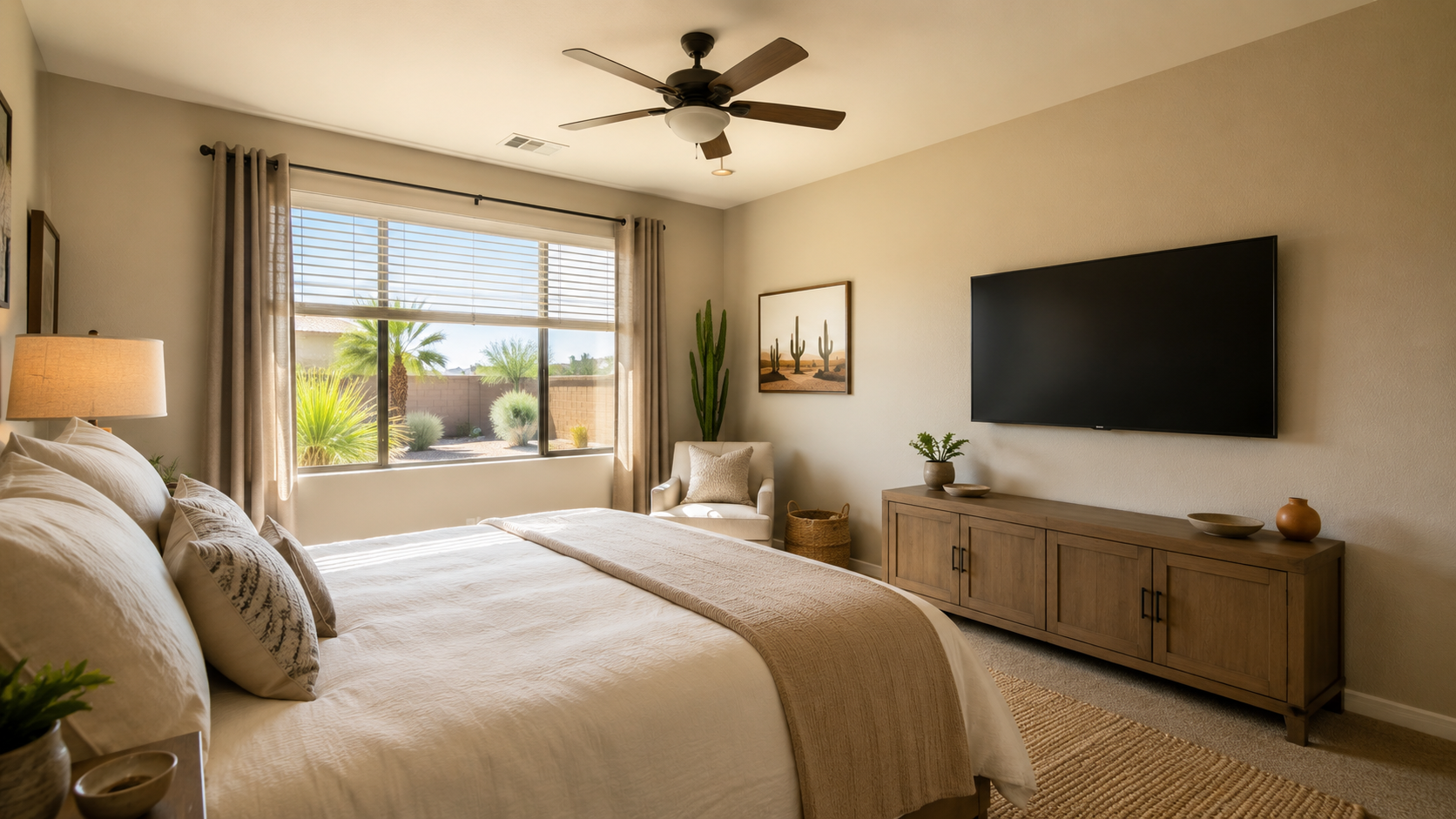
Installing a TV in the bedroom is a project that requires the right approach. The height of your TV directly affects viewing comfort, eye strain, and the position of your neck and back. In this article, we will explain the best height to mount a TV in a bedroom, how to consider the size of the screen, the height of your bed, and the layout of the room, so you can create a comfortable space for relaxing and watching your favorite movies, shows, and sports.
One of the most common questions homeowners ask is: how high should a TV be mounted in a bedroom in Phoenix, AZ?
In Phoenix, Arizona, where many homes have spacious primary bedrooms, large beds, high ceilings, and open floor plans, choosing the right TV height is especially important. The bedroom is not only a place for sleep. It is also a place where many people relax, watch movies, catch up on shows, or enjoy quiet time at the end of the day.
That is why it is important to determine the proper TV mounting height before drilling into the wall. A TV that is installed too high or too low can make viewing uncomfortable, cause neck tension, and create unnecessary eye fatigue.
When choosing the correct height for bedroom TV mounting, you should first consider your furniture — especially the height and design of your bed. The position in which you usually watch TV, whether lying down, sitting up, or reclining against pillows, directly affects where the TV should be mounted.
The ideal TV height in a bedroom depends on several factors: the height of the bed, the size of the TV, the viewing distance, the type of wall mount, and your personal viewing habits. When installed correctly, the TV will be comfortable to watch and can help prevent future discomfort in your eyes, neck, shoulders, and back.
The design of your bed plays a major role in deciding how high to mount a TV in the bedroom.
Common bedroom setups include:
Beds with a tall upholstered headboard
The shape and comfort of your headboard affect how you watch TV. Some people sit upright with their back supported. Others recline with pillows. Some watch TV mostly while lying down. This position is the key factor when choosing the correct TV mounting height.
A bed with a tall, soft headboard usually allows you to watch TV comfortably while sitting or reclining. A bed without a headboard often makes it more natural to watch TV while lying down. If the headboard is too low, too hard, or uncomfortable, the viewer may slide down into a lying position, which changes the ideal viewing angle.
A bed with a tall headboard is usually comfortable for reading, sitting, and watching TV.
A bed with an uncomfortable headboard may cause pressure on the back and neck during longer viewing sessions.
A bed with no headboard may require the TV to be mounted slightly higher, especially if the viewer watches from a lying position.
Before installing a TV in the bedroom, we recommend using this simple method:
Sit or lie on your bed in the position that feels most natural and comfortable.
Use your regular pillows or lean against the headboard if you have one.
Imagine that you will spend a few hours in this position watching TV.
Close your eyes, relax your body, and then open your eyes.
The point on the wall where your eyes naturally land should be close to the center of the TV screen.
This method helps you find a personalized TV height based on your actual viewing position, rather than using a generic number.
If you plan to watch TV mostly while lying down, the center of the screen can usually be placed about 6 to 10 inches higher than the eye-level point you would use for a sitting or reclining position.
The most important rule is this: do not mount the TV too low. If the TV is too low while you are lying down, you may have to constantly lift your head with extra pillows, which can bend the neck and cause discomfort over time.
A properly selected bedroom TV height allows you to watch comfortably and helps reduce stress on your neck and eyes.
If you plan to watch TV mostly while lying down, finding the ideal mounting height is fairly simple.
Lie on the bed in your normal comfortable position.
Place a pillow under your head the way you usually do.
Slightly bend your knees and place your feet on the bed.
Look toward the wall where the TV will be installed.
Mark the lowest point where the TV can be mounted without your knees blocking the screen.
From our professional experience, the bottom edge of the TV is often best placed about 20 to 24 inches above the top of the mattress.
For example, if your bed height from the floor to the top of the mattress is about 24 inches, the bottom edge of the TV may work well at approximately 44 to 48 inches from the floor.
This is not a universal rule for every bedroom, but it is a helpful starting point for many standard setups.
For professional bedroom TV mounting and setup in Phoenix and Scottsdale, contact the TV Mountology team. We can help you choose the right height, the right wall mount, and the safest installation method for your space.
Mounting a TV in the bedroom requires careful planning. It is not only about securing the TV to the wall. It is also about comfort, safety, cable placement, and viewing angle. A poorly selected TV height or wall location can lead to screen glare, awkward viewing angles, visible wires, blocked outlets, or neck pain. Below is a step-by-step guide on how to mount a bedroom TV correctly, from selecting the wall mount to installing the TV on the wall. Following these steps can help you achieve a safe, clean, and comfortable installation.
The first step is choosing the correct TV wall mount. For bedroom installations, the most common options are fixed mounts and tilting mounts. A tilting TV mount is useful if there is a strong light source or window behind the bed. The tilt can help reduce glare on the screen. However, a tilting mount is not always necessary. In many bedrooms, a low-profile fixed mount is the cleanest and most elegant choice. When selecting a mount, it is important to consider the location of power outlets, cable connections, and low-voltage plates behind the TV.
Remember: electrical outlets and cable boxes are one of the most common reasons why a TV cannot be mounted exactly where the homeowner originally wanted it.
If an outlet or cable plate is directly in the way of the mounting bracket, the TV may need to be moved slightly higher, lower, left, or right. That is why it is always important to check the wall before installation.
For most bedroom TV installations, a low-profile fixed TV mount is the most universal and clean-looking option.
Let’s look at an example using a 50-inch Samsung TV.
Measure the distance from the floor to the top of your mattress.
In many bedrooms, this height may be around 22 to 26 inches, depending on the bed frame, mattress, and topper.
Add about 20 to 24 inches to the height of your mattress.
Make a mark on the wall across from the bed using painter’s tape or a pencil.
This mark will represent the bottom edge of the TV.
For example:
If the bed height is 24 inches, the bottom edge of the TV may be around 44 to 48 inches from the floor.
Take the TV wall mount and place the vertical mounting arms against the back of the TV.
Align the mounting holes on the TV with the holes on the bracket arms.
Secure the mounting arms using the screws included with the mount.
Make sure the screws are the correct length for the TV. Screws that are too short may not hold properly. Screws that are too long can damage the TV.
After the mounting arms are attached to the back of the TV, measure the distance from the bottom edge of the TV to the lowest point of the bracket.
This measurement is important because the wall bracket itself does not usually line up with the bottom edge of the TV.
Go back to the wall mark you made earlier for the bottom edge of the TV.
From that mark, measure upward using the distance you calculated in the previous step.
Make a new mark on the wall.
This new mark will show where the bottom of the wall bracket should be installed.
Take the horizontal wall plate of the TV mount and place it against the wall at the mark from the previous step.
If needed, temporarily hang one or two vertical bracket arms on the wall plate to confirm the correct position.
This helps you visualize how the TV will sit on the wall before drilling.
Before drilling, make sure the bracket does not overlap with electrical outlets, cable plates, or low-voltage boxes.
If any part of the bracket blocks an outlet, try adjusting the bracket position.
Depending on the TV and bracket design, you may be able to move the mounting arms slightly higher or lower on the TV. You may also need to adjust the final TV height slightly.
This step is very important for a clean and safe installation.
Install the wall bracket using the correct hardware for your wall type.
Common wall types in Phoenix homes may include:
For drywall installations, the bracket should usually be secured into wall studs, not just drywall. The correct anchors and fasteners depend on the wall material and the weight of the TV.
Use a bubble level or laser level to make sure the wall bracket is perfectly straight.
Even a small mistake can make the TV look crooked once it is mounted.
Before lifting the TV, make sure the vertical mounting arms are firmly attached to the TV.
Check all screws and make sure the bracket arms are secure.
With another person helping you, carefully lift the TV and hang it on the wall bracket.
Do not try to lift a large TV by yourself. Even a 50-inch TV can be difficult to handle safely, especially in a bedroom with furniture nearby.
Many TV mounts include a locking mechanism, safety screw, or locking bar.
This part prevents the TV from accidentally sliding off or being lifted off the mount.
Do not skip this step.
After the TV is mounted, check the height from the floor.
If you followed the instructions correctly, the bottom edge of the TV should line up with the original mark you made on the wall.
Now sit or lie on the bed and confirm that the screen feels comfortable to watch.
Congratulations. Your bedroom TV is now mounted at a comfortable height for viewing from bed.
Although TV mounting may look simple, a proper installation requires experience, precision, and the right tools.
A professional installer can help you:
This is especially important in Phoenix and Scottsdale homes where many bedrooms have large wall spaces, high ceilings, custom cabinetry, fireplaces, or specialty wall surfaces.
If you want your bedroom TV mounted safely, cleanly, and at the right height, contact TV Mountology.
Our team provides professional TV mounting and installation services in Phoenix, Scottsdale, and nearby Arizona communities. We help homeowners create a comfortable viewing setup with the right TV height, secure mounting, clean cable management, and a polished final look.
Whether you need a fixed mount, tilting mount, soundbar mounting, wire concealment, TV dismounting, or remounting, TV Mountology can help you get the job done right.
📞 Call us today at (602) 910-8876 and schedule your installation with the Valley’s trusted professionals.
